
What Manufacturing Optimization Means
Manufacturing optimization is the systematic improvement of how a facility converts inputs — energy, raw material, labor, and machine time — into finished product. It is not a single project or a piece of software. It is a connected set of practices covering energy performance, maintenance and reliability, process visibility, automation and controls, and operating discipline.
A useful way to think about it: every facility has a theoretical best performance, defined by its equipment and process design. The gap between that and actual daily performance is filled with losses — energy waste, downtime, rework, idle running, and poor coordination. Optimization is the work of closing that gap, starting with the losses that are largest and easiest to correct.
This is why industrial optimization is best treated as an engineering program rather than a one-time intervention. The facilities that improve sustainably are the ones that measure first, prioritize deliberately, and verify results after each change.
Why Optimization Matters for Factories in Iraq
Industrial facilities in Iraq and the Kurdistan Region operate under conditions that make efficiency more valuable, not less. Grid instability and partial reliance on diesel generation mean that every wasted kilowatt-hour is often paid for at generator cost, not grid cost. Spare parts and specialist services can take longer to source, which raises the real price of unplanned downtime. And in many sectors, competition from imported goods puts continuous pressure on production cost per unit.
In this environment, factory performance improvement is not an abstract goal. A facility that reduces its energy intensity, shortens its downtime, and stabilizes its quality output gains a direct cost advantage — one that compounds month after month. Optimization also strengthens resilience: a plant with disciplined maintenance and good process visibility recovers faster from power disturbances, supply interruptions, and equipment problems.
Common Sources of Manufacturing Loss
Most facilities share a familiar set of loss categories. Recognizing them is the first step toward addressing them.
- Energy waste. Equipment left running during breaks and changeovers, oversized machines operating at partial load, poor power factor, and uncontrolled heating or cooling all add cost without adding product.
- Compressed air losses. Compressed air is one of the most expensive utilities in any plant, and leaks are almost universal. A system that has never been leak-surveyed is very likely paying for air that never reaches a tool or process.
- Inefficient motors, pumps, fans, and compressors. Rotating equipment often runs far from its efficient operating point — throttled pumps, dampered fans, and fixed-speed motors driving variable loads. These are classic candidates for measurement and correction.
- Poor maintenance discipline. When maintenance is reactive rather than planned, equipment degrades faster, energy consumption creeps upward, and small defects grow into failures. Missing lubrication routines, ignored vibration, and undocumented repairs all carry hidden costs.
- Unplanned downtime. Every unexpected stop costs production time, often scraps in-process material, and disrupts schedules downstream. Facilities that do not track downtime causes usually underestimate how much they lose to it.
- Production bottlenecks. One slow machine, one congested transfer point, or one understaffed station can limit the output of an entire line while every other asset waits.
- Poor operating schedules. Running energy-intensive equipment during peak generator load, idling lines between shifts, or starting large machines without sequencing all waste energy and capacity.
- Weak monitoring and lack of data. Without measurement, losses are invisible. Many facilities cannot say how much energy each major load consumes, how often each machine stops, or what their real cost per unit is.
- Quality rejects and rework. Every rejected product consumed full energy, material, and machine time. Rework doubles the cost of the same output. Quality losses are energy losses and capacity losses at the same time.
- Poor coordination between production and maintenance. When the two functions plan separately, maintenance windows are missed, equipment is run to failure to meet short-term targets, and both sides lose.
Few of these losses announce themselves. They are found through measurement, inspection, and structured review — which is exactly what an optimization program provides.
Energy Efficiency and Manufacturing Performance Are Connected
It is common to treat energy as a utility bill and production as a separate concern. In practice, the two are tightly linked. A plant's energy consumption per unit of product is one of the most honest indicators of its overall health.
When equipment is well maintained, it consumes less energy. When production runs without interruption, fixed energy loads are spread over more output. When processes are controlled properly, less material is rejected and less energy is spent producing scrap. Improving energy performance therefore tends to improve production performance, and vice versa — the same measurements that reveal energy waste usually reveal process and reliability problems as well.
This is why an energy audit is often the most effective entry point into a broader optimization program. It puts instruments on the facility, establishes a measured baseline, and surfaces issues that affect both the energy bill and the production schedule.
Maintenance and Reliability as Optimization Tools
Maintenance is sometimes seen as a cost center to be minimized. In an optimization program, it is the opposite: a tool for protecting capacity and efficiency.
A facility with planned, documented maintenance experiences fewer unplanned stops, keeps equipment closer to its design efficiency, and extends asset life. Moving from reactive repair toward planned and preventive maintenance — supported by basic condition monitoring and a structured record of work — is one of the highest-value changes most regional facilities can make.
This does not require an immediate jump to advanced systems. It starts with fundamentals: a complete asset register, defined routines for critical equipment, recorded failure causes, and a clear interface between production and maintenance planning. A practical path toward maintenance planning and CMMS readinessbuilds these habits first, so that any software introduced later manages a working system rather than digitizing a broken one.
The Role of Automation, Controls, and IIoT
Automation and industrial IoT are often presented as the starting point of smart manufacturing. In a disciplined program, they come after the fundamentals — but they matter greatly.
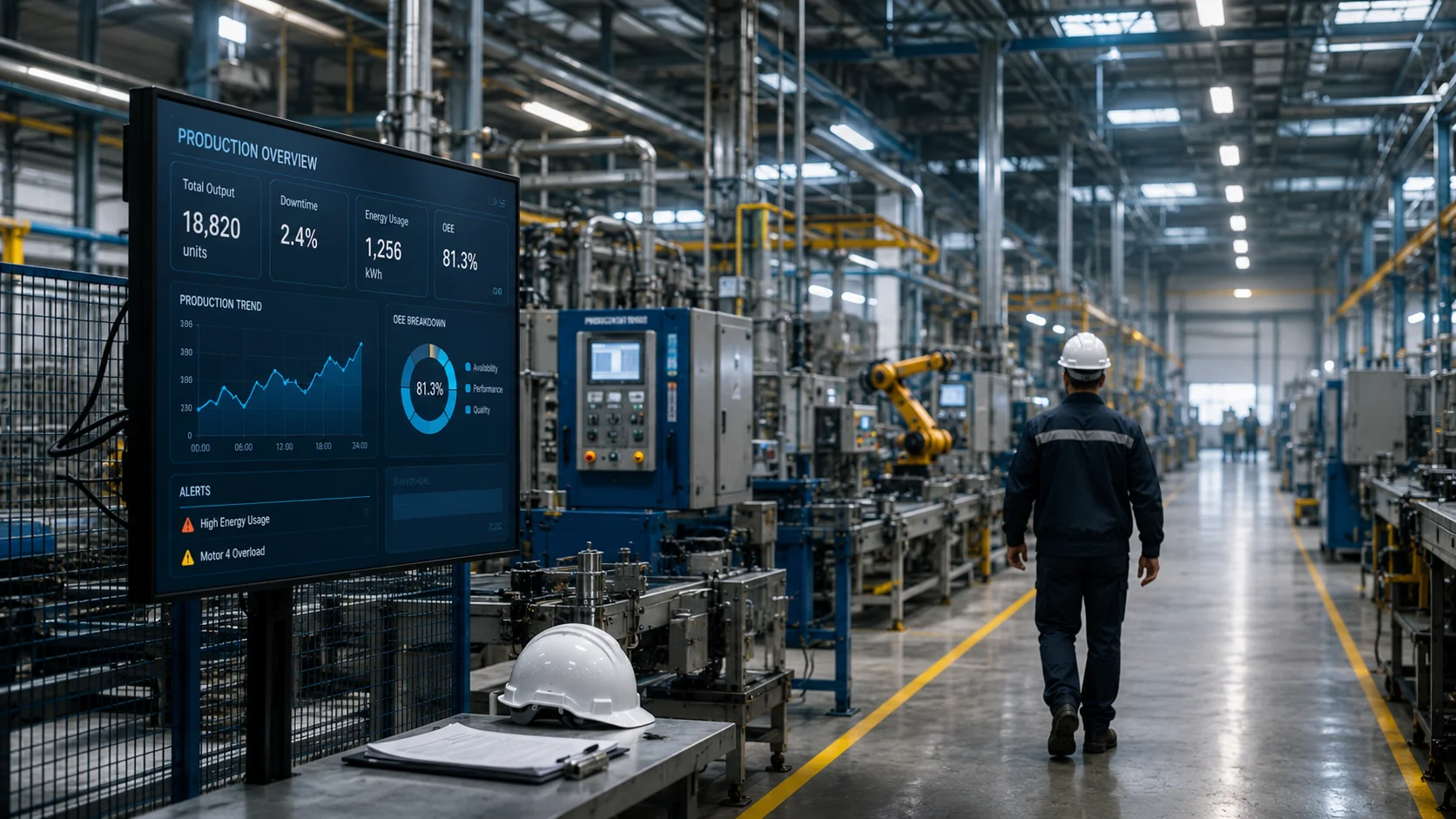
Good control systems remove dependence on manual habits: equipment starts and stops when the process requires it, setpoints are held consistently, and sequences run the same way on every shift. Variable speed drives match motor output to actual demand. Monitoring systems make energy consumption, machine status, and downtime visible in near real time, turning invisible losses into managed numbers.
The right approach for most facilities in Iraq is incremental. Instrument the major loads first. Add control where the payback is clear. Build visibility before building complexity. Automation, controls, and IIoT deliver the most value when they are layered onto a plant that already understands its baseline — and they then make every future improvement easier to verify and sustain.
Practical First Steps for a Manufacturing Optimization Program
A facility does not need a transformation project to begin. A credible program usually follows a sequence like this:
- Baseline current performance. Establish what the facility actually consumes and produces today — energy use, output, downtime hours, and reject rates — using measured data wherever possible.
- Identify major loads and bottlenecks. Find the equipment that consumes the most energy and the process steps that limit output. These define where attention pays back fastest.
- Review maintenance records. Examine what has failed, how often, and why. Repeated failures point directly at reliability and efficiency losses.
- Measure key equipment. Put instruments on critical motors, compressors, pumps, and process equipment. Measurement replaces assumption and reveals problems that walkthroughs miss.
- Prioritize improvement opportunities. Rank findings by cost, savings potential, implementation effort, and risk. Not everything needs to be fixed at once.
- Start with low-risk corrective actions. Leak repairs, schedule changes, control adjustments, and maintenance corrections build savings and confidence before larger investments are considered.
- Verify results after implementation. Re-measure after each change. Verified results protect the budget, build internal support, and keep the program honest.
This sequence is deliberately conservative. It produces early wins, avoids unnecessary capital spending, and builds the data foundation that larger projects require.
How MesoAxis Approaches Manufacturing Optimization
MesoAxis treats manufacturing optimization as a connected engineering discipline rather than a collection of separate services. The starting point is usually a measured energy audit, because it establishes the facility baseline with instruments rather than estimates. From that baseline, the work extends into industrial optimization — addressing process losses, bottlenecks, and operating discipline — and into maintenance planning and CMMS readiness, so reliability improvements are structured and sustained.
Where monitoring and control gaps limit a facility, MesoAxis supports automation, controls, and IIoT implementation, scaled to what the plant actually needs. Throughout the program, engineering review and implementation support keep findings connected to executed results: opportunities are prioritized by measured value, corrective actions are specified properly, and outcomes are verified after implementation.
The objective is straightforward — a facility that knows its numbers, controls its losses, and improves on evidence rather than assumption.
Which Facilities Benefit Most
Manufacturing optimization applies across industries, but it delivers particular value in facilities with significant energy use, rotating equipment, and continuous or batch production, including:
- Manufacturing plants of all types, from light assembly to heavy process production
- Cement, concrete, and block plants, where grinding, mixing, and material handling dominate energy use
- Steel and metalworking manufacturers, with high electrical loads and demanding equipment duty
- Food and beverage facilities, where refrigeration, steam, compressed air, and hygiene-driven processes carry constant cost
- Oil and gas support facilities, where reliability and uptime directly affect contractual performance
- Power-related facilities, where auxiliary loads, fuel handling, and maintenance discipline shape operating cost
More detail on how these sectors are served is available on the industries page. In each of these environments, the loss categories differ in proportion but not in nature — and the same structured approach applies.
Conclusion
Manufacturing optimization is not about producing faster at any cost. It is about removing the waste, downtime, energy loss, and inefficient habits that quietly erode a facility's performance every day. For factories in Iraq and the Kurdistan Region, the combination of high energy cost, generator dependency, and competitive pressure makes this work especially worthwhile — and the most effective programs begin not with technology purchases, but with measurement, prioritization, and disciplined execution.
If you would like to understand where your facility stands and which improvements would deliver the most value,contact MesoAxis to discuss a structured assessment of your operation.